
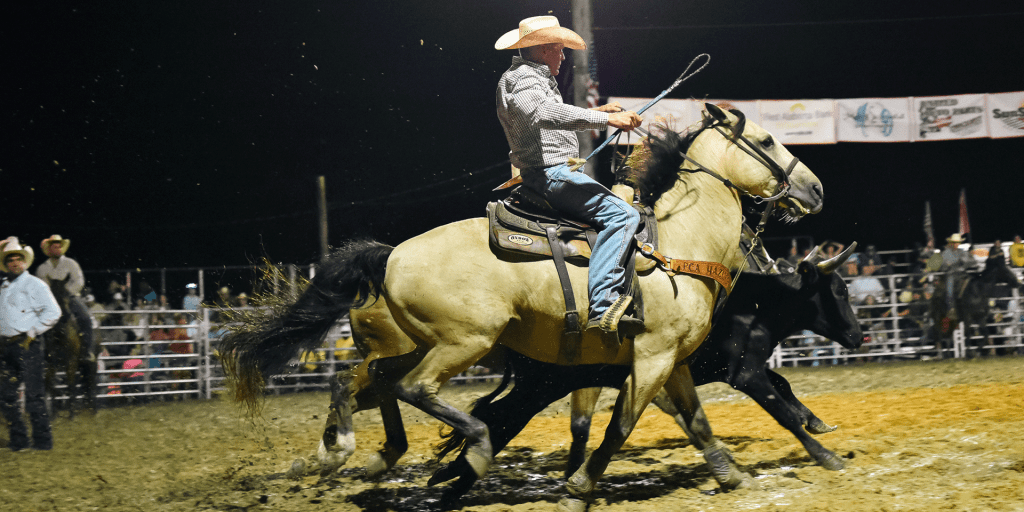
On a warm summer weekend in late July, the small town of Butler, Alabama, population 1,700 and change, became the unlikely epicenter of a uniquely American art form. Beneath a sky brushed with heat lightning and the smell of hay, the Boots For Glory Veteran’s Rodeo took over the Butler Rodeo Grounds on July 27 and 28, transforming the town into something larger than itself. Hundreds of visitors poured in from Wilcox, Marengo, Clarke, and Washington counties, drawn not just by the promise of spectacle, but by a deeper call: the enduring poetry of the rodeo and the solemn honoring of American veterans.
To the uninitiated, rodeo might appear as little more than rural entertainment, a fast, dusty montage of bucking animals and ten-gallon hats. But for those who know, who’ve inhaled the sharp tang of leather and sweat in the back pens, who understand that this is not merely performance but discipline, the rodeo is closer to dance than combat, closer to ritual than routine. It is a living testament to balance, pain, timing, and trust, between rider and horse, rope and calf, body and ground.
The Boots For Glory event was more than a showcase. It was a convergence. A celebration of both athleticism and heritage, of grit and generosity. At its heart, the rodeo has always been about storytelling, each event an encounter between human will and untamed nature. And over the course of two nights, that story unfolded again and again beneath the bleachers and the big lights.
When the first rider emerged from the chute, the arena burst to life. The air, thick with anticipation, quivered with the low rumble of hooves pounding earth. Bull riding, the undeniable centerpiece of any rodeo, launched the evening with primal energy. Each ride lasted only seconds, eight, if the cowboy was lucky, but within that short span was a world of tension. The bull, a creature of pure muscle and defiance, spun and twisted like a storm. The rider, one hand clenched, the other high in the air like a conductor leading chaos, rode not against the animal, but with it. That’s the paradox of bull riding: the goal is to survive the fury without ever resisting it too hard.
And yet, it wasn’t only the bull riders who stole the show. Barrel racing, long considered the rodeo’s most elegant event, delivered moments of true beauty. Women and girls, some barely in their teens, leaned into each turn with the grace of seasoned jockeys. The speed was blistering, but the control was absolute. Horse and rider moved as one, feminine energy channeled through horsepower and grit, circling barrels in a tight cloverleaf pattern before gunning for the finish. It was as much a performance of trust as of timing.
Calf roping brought another flavor of precision. Here, the cowboy’s rope became an extension of his own intention, arcing through the air before tightening around a fleeing calf’s neck in a motion so swift it felt like sleight of hand. Then came the quick dismount, the binding, the flag drop. It was over before most spectators even processed the sequence, but it was in those seconds that the long history of ranch work and survival in the American South and West became art.
And there was bronc riding, perhaps the most poetic of all. To stay atop a bucking horse, a cowboy must surrender the idea of complete control. He must move with the chaos, not against it. The best rides were less about domination than harmony, a rough choreography set to the rhythms of nature and necessity. These riders, silhouettes in the dusk, seemed to float for brief, suspended moments, arms out like wings before the inevitable fall.
But even the thunder of hooves was occasionally silenced for something just as powerful: gratitude. Between events, local veterans were brought into the spotlight, not for competition, but for recognition. Their names were read aloud, their sacrifices recounted, and the audience rose, not in frenzy, but in reverence. The rodeo, after all, is a world where respect is currency. Where history is lived, not just told. And honoring those who served in uniform brought the night’s thrills back down to earth with a reminder of real courage.
Beyond the arena, the grounds were alive with color and conversation. Children ran with flags and sticky fingers. Vendors sold barbecue ribs lacquered in sauce, fresh-squeezed lemonade, and kettle corn that snapped in your teeth. There were booths offering hand-tooled leather belts, turquoise jewelry, and hand-sewn crafts, all a reminder that this was not just a sporting event but a cultural gathering. A celebration of what rural America still is, and what it dreams of remaining.
As the final ride ended and the dust began to settle, something lingered in the humid Alabama air. It wasn’t just excitement, it was belonging. The Boots For Glory Veteran’s Rodeo had given Butler something more than entertainment: it gave the community a mirror, a moment to see itself reflected in both its raw strength and its deep tenderness.
In the days that followed, talk of the rodeo rippled through diners, gas stations, and church pews. Kids mimicked riders in schoolyards. Veterans spoke of quiet pride. And somewhere, perhaps, a young boy or girl picked up a rope for the first time, inspired not by fame or spectacle, but by the roar of a crowd and the whisper of tradition.
Because rodeo is not a sport you watch. It’s a story you join.
 Caster Studio